
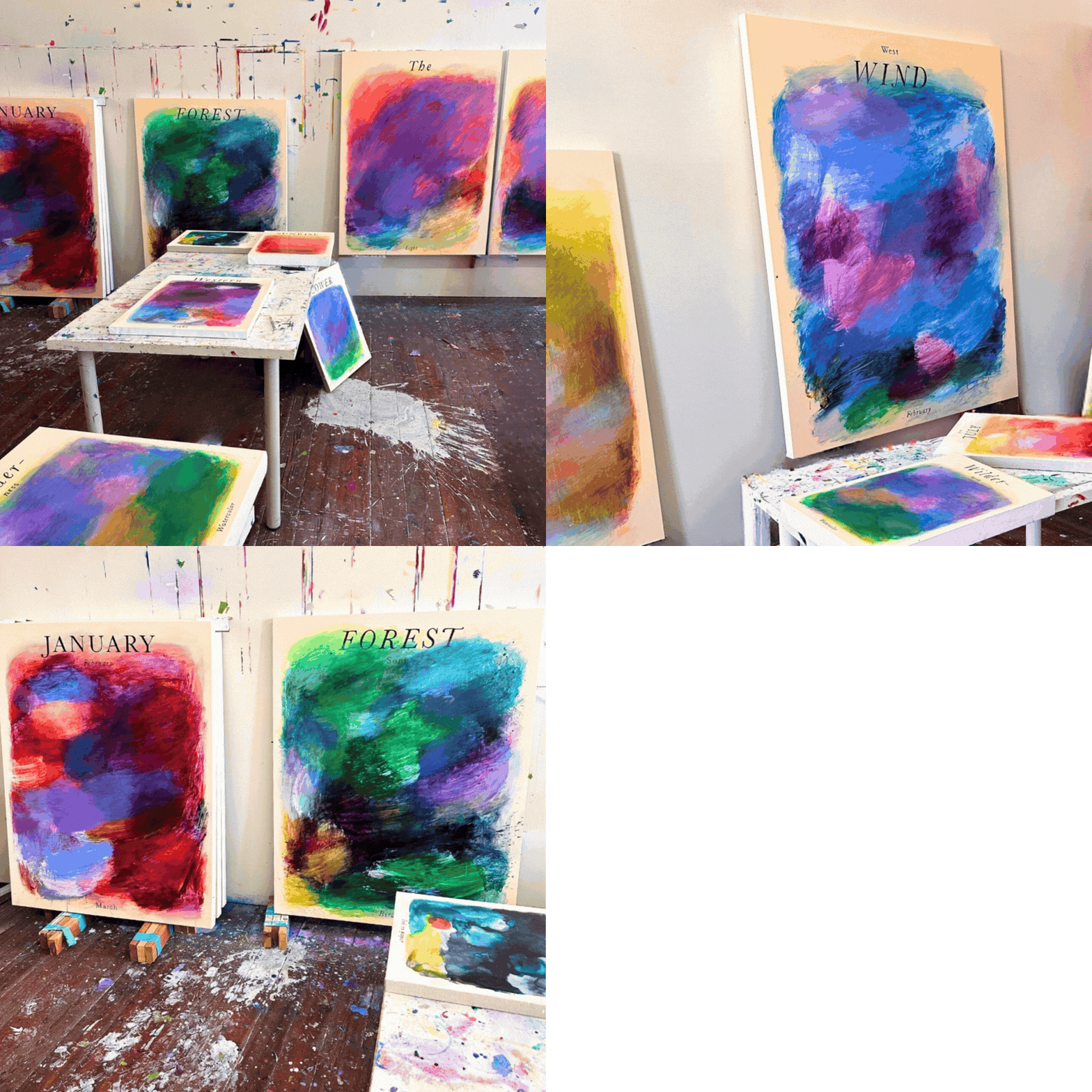
Created in the context of his exhibition West Wind, Andrew Kuo’s recent paintings bring together gestural color fields and handwritten text that moves between language, memory, and abstraction.
Across the series, fragments of words and phrases appear directly within the paintings, functioning less as fixed statements and more as shifting elements within the composition itself. References to landscape, sensation, correspondence, and observation move throughout the works, where text and image develop alongside one another through repetition, revision, and instinct.
Many of the paintings reference places in the American West, including Aspen and its surrounding terrain, while also emerging from a process shaped by research, memory, and projection.
We spoke with Kuo about the role of language in his work and the rhythms that shape his studio practice.
Your paintings pair images with handwritten text. What role does language play in this series, and why did it feel important to include words alongside the imagery?
The text grew out of a project during lockdown, when I was thinking a lot about communication and correspondence. It became a way to continue working while being physically isolated. The language in these paintings reflects that moment. It’s about sending and receiving messages, about poetry, about connection. It’s intentionally loose and suggestive, pointing toward ideas like places, colors, or sensations rather than defining them.
The text in these works reads almost like fragments of letters or poems. What is happening in the language here? Do you think of these passages as poetry, notes to yourself, or something else entirely?
Painting, like writing, is tied to time and experience, and the language reflects that. The words are connected to the moment in which they’re made, and to the artist, but they don’t resolve into a single category. They’re not strictly letters or poems or notes, but something that moves between those forms. Across the series, the works begin to speak to one another, forming a shared rhythm of thought.

Andrew Kuo, THE FLOWERS, 2026
Oil on canvas
68 x 52 1/2 in
Language has appeared in your work before, but it feels different in this series. How has your relationship to text evolved, and what feels new about how you are using it here?
In earlier work, I was more focused on structuring relationships between language and color. Here, the approach is looser. The paintings lean more heavily on color and instinct, and the words intervene in a more playful way. I’m interested in how a word can redirect how a painting is experienced, even slightly, and how that creates a different kind of engagement.
Can you share something about your studio rhythm while making these works? Is there a ritual, habit, or environment that helps bring both the images and the words into the painting?
Getting into the work takes time. There’s a lot of waiting, resetting, and clearing space before anything happens. For this series, I avoided podcasts and listened mostly to music without words, trying to simplify my thinking and remove distractions.
I was interested in working from a place of not knowing, where things feel more instinctive. That mental state is what allows the paintings to come together.

West Wind is on view through April 30, 2026.
